
What sound waves, water, humming and silence can reveal
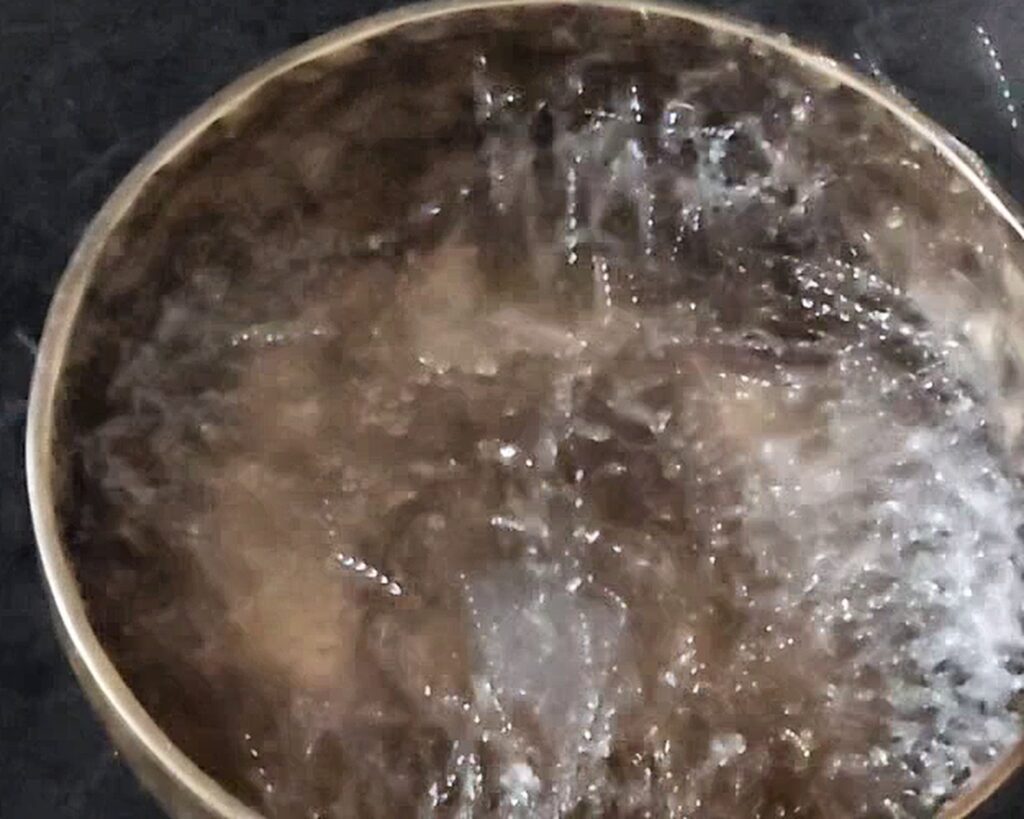
Sound made visible as vibration moves through water.
Most of us think of sound as something we hear. Yet sound is also movement. It travels through air, water and solid matter, and we may feel it through the whole body.
A deep drum can be felt in the chest. Our own voice vibrates through the face and throat. A singing bowl may be sensed through the hands.
For people who feel tired, overstimulated, tense or unable to settle, sound can offer a direct way to rest. You can listen, feel and notice what happens.
Sound begins with vibration
Every sound begins with something moving.
A string is plucked. A bowl is struck. Air passes through the vocal folds. These movements create sound waves that travel through the surrounding air.
Sound also travels through water and solid materials. This is why music may be felt through the floor, or the vibration of a singing bowl through your hands as you hold it.
Frequency describes how quickly something vibrates. Slower vibrations create lower sounds, while faster vibrations create higher ones. Most sounds contain several frequencies, while an instrument’s material and shape give it its particular character.
Sound is physical, even when we cannot see it.
Sound moves water, making vibration visible
Up to around 60 per cent of the adult human body is water, while many organs contain considerably more. The brain and heart are around 73 per cent water, the lungs about 83 per cent, and the muscles and kidneys around 79 per cent.
What happens when sound meets water?
When a singing bowl containing water is played, the vibration passes into the water. Fine ripples appear. As the vibration grows, the ripples meet and form increasingly complex patterns. Sometimes tiny droplets rise and dance across the surface.
You cannot see sound itself, but you can see what it does.
The study of patterns created through sound and vibration is often known as cymatics.
More than two centuries ago, the musician and scientist Ernst Chladni scattered sand across metal plates and drew a violin bow along their edges. The sand gathered along still points, forming intricate geometric shapes. Different tones produced different patterns.
Sound became visible.
Sound is used in medicine
The ability of sound waves to travel through and interact with the body is already used in familiar medical treatments.
Ultrasound sends high-frequency sound waves into the body. Their reflections are used to create images of organs, blood flow and a baby developing in the womb.
Shock-wave lithotripsy uses focused pressure waves to break kidney stones into smaller pieces that can pass more easily from the body.
These medical applications are very different from therapeutic sound. They remind us that sound is a physical energy that can interact with matter.
Your voice is an instrument
The most personal sound instrument you have is your own voice.
When you hum, the sound begins inside your body. You may feel vibration around the lips, face, throat, chest or head. Place your fingertips gently on your cheeks or breastbone as you hum and notice what you can feel.
Humming and vocal sound have long been part of yoga and many cultural and spiritual traditions. No singing ability is needed. Your natural hum is enough.
Humming also changes the movement of air between the nose and sinuses. A small study found that nasal nitric oxide increased fifteenfold during humming compared with quiet exhalation. This offers an interesting glimpse of how vocal vibration affects the body.
Jonathan and Andi Goldman explore conscious humming in The Humming Effect, bringing together traditional sound practices and modern interest in the voice as a readily available source of vibration.
Why some sounds feel harmonious
Harmony is created through relationship.
In its simplest form, a perfect fifth brings together two notes with a frequency relationship of 3:2. Their overtones fit together closely, creating an open and spacious quality.
The perfect fifth appears throughout many forms of music and is often heard as especially harmonious. Culture, memory and musical experience also shape our response.
Many people experience a perfect fifth as calming. Others are drawn to its clear, spacious quality.
There is no single tone that will affect everybody in the same way. Our responses are shaped by our hearing, health, memories, culture and what we are living through at the time.
Can sound help us retune?
People sometimes describe therapeutic sound as helping them to retune.
I use that word carefully. The body is not a piano with one correct pitch, and wellbeing cannot be reduced to finding one particular “healing frequency”. Yet the image can still be useful.
After stress, illness, pain, fatigue or change, we may feel out of rhythm with ourselves. A steady tone, gentle pulse or harmonious interval gives us something clear to follow. We may begin to notice the breath, places of tension and subtle changes in the body.
We listen and notice what happens.
Water, words and unanswered questions
Water continues to inspire research, imagination and debate.
Masaru Emoto became widely known for photographing frozen water crystals after exposing water to words, music, images and human intention. His well-known comparisons included loving and appreciative words alongside angry or hostile ones. The published photographs showed strikingly different crystal formations under the different conditions.
Small double-blind and triple-blind studies also found that crystals formed from water receiving positive intention were rated as more beautiful than crystals from control samples. The word and music comparisons have not yet been widely repeated by independent research teams, so there is still much to explore.
Perhaps the idea feels compelling because we recognise something similar within ourselves.
An angry voice, a sudden alarm or the relentless sound of a pneumatic drill can bring tension into the body almost immediately. A kind voice, a familiar piece of music or the sounds of water and birds may affect us very differently. Even music is personal: a sound one person enjoys may feel uncomfortable to another.
Sound carries rhythm, tone and intensity. It can also convey intention and affect how we feel in both body and mind.
Veda Austin has continued to explore the forms that appear as water freezes, describing them as responses to words, images, thoughts and their surroundings.
How much do we already understand about the responsiveness of water, and how much remains unknown?
Fabien Maman, a musician and acupuncturist, has also been influential in the development of contemporary sound healing. Through Tama-Do, he brought together acoustic sound, tuning forks, colour, movement and ideas drawn from acupuncture and energetic traditions.
His approach is spiritual and energetic, very different from the established medical uses of ultrasound and shock waves.
There is room here for ancient understanding, lived experience, scientific investigation and questions that remain unanswered.
Sound and silence belong together
Sound draws our attention, though silence often reveals what has changed.
A bowl rings and gradually fades. A hum ends. For a few moments, the sound may still seem present, even though the room has become quiet.
Perhaps the breathing has shifted. The body feels heavier or lighter. Sensations seem clearer. Sometimes very little appears to happen until the sound subsides.
Silence is part of the experience.
Sound is something we hear. Vibration is something we feel. Together, sound and silence may give us another way to listen to ourselves.
Individual Sound Healing, Relaxation & Meditation Sessions
I offer individual sound healing, relaxation and meditation sessions for people seeking deep rest, relief from stress or a more personal way to experience sound.
Each session is shaped around you and what you need at the time. It may include singing bowls, tuning forks, voice, gentle vibration, meditation and silence.
You can be seated or lying down, according to what is most comfortable for you.
Please contact me to ask about individual sessions at Chinnor Village Centre or appointments elsewhere.
Sources and further reading
- OpenStax: Speed of Sound, Frequency and Wavelength
- US Geological Survey: Water and the Human Body
- Terwagne and Bush: Tibetan Singing Bowls
- Smithsonian: Chladni Plates and Visible Sound Patterns
- US Food and Drug Administration: Ultrasound Imaging
- NHS: Kidney Stones and Shock-Wave Lithotripsy
- Weitzberg and Lundberg: Humming and Nasal Nitric Oxide
- Jonathan and Andi Goldman: The Humming Effect
- The Physics Classroom: Pitch, Frequency and Musical Intervals
- Office Masaru Emoto: Message from Water
- Double-Blind Test of Distant Intention and Water-Crystal Formation
- Triple-Blind Replication of the Water-Crystal Experiment
- Veda Austin: Water Crystallography
- Fabien Maman and the Tama-Do Academy
© Suzan Joy Wells 2026. All rights reserved.
